Business Ethics: Case Studies and Selected Readings, 9th Edition Pdf Download

Philosophers of police force ask "what is police force, and what should information technology be?"
Jurisprudence, or legal theory, is the theoretical written report of the propriety of law. Scholars of jurisprudence seek to explicate the nature of law in its nigh general form and provide a deeper understanding of legal reasoning and illustration, legal systems, legal institutions, and the proper application and function of law in society.[1]
Modern jurisprudence began in the 18th century and was focused on the first principles of natural constabulary, civil law, and the law of nations.[two] General jurisprudence can be divided into categories both by the type of question scholars seek to answer and past the theories of jurisprudence, or schools of thought, regarding how those questions are best answered. Contemporary philosophy of law, which deals with general jurisprudence, addresses issues internal to law and legal systems and bug of constabulary as a social institution that relates to the larger political and social context in which information technology exists.[3]
This article addresses three distinct branches of thought in general jurisprudence. Ancient natural law is the idea that there are rational objective limits to the power of legislative rulers. The foundations of police are accessible through reason, and it is from these laws of nature that homo laws gain whatsoever force they take.[3] Analytic jurisprudence (Clarificatory jurisprudence) rejects natural law's fusing of what law is and what it ought to be. It espouses the use of a neutral point of view and descriptive language when referring to aspects of legal systems.[four] Information technology encompasses such theories of jurisprudence as "legal positivism", which holds that there is no necessary connection between law and morality and that the force of constabulary comes from basic social facts;[five] and "legal realism", which argues that the real-world practice of law determines what law is, the law having the force that it does because of what legislators, lawyers, and judges do with it. Normative jurisprudence is concerned with "evaluative" theories of constabulary. It deals with what the goal or purpose of law is, or what moral or political theories provide a foundation for the law. It not just addresses the question "What is law?", merely besides tries to determine what the proper function of police force should be, or what sorts of acts should exist subject field to legal sanctions, and what sorts of penalty should be permitted.
Etymology [edit]
The English word is derived from the Latin, iurisprudentia.[6] Iuris is the genitive class of ius significant law, and prudentia pregnant prudence (also: discretion, foresight, forethought, circumspection). It refers to the exercise of good judgment, mutual sense, and caution, peculiarly in the carry of practical matters. The give-and-take get-go appeared in written English[seven] in 1628, at a time when the give-and-take prudence meant cognition of, or skill in, a matter. It may accept entered English via the French jurisprudence, which appeared earlier.
History [edit]
Ancient Indian jurisprudence is mentioned in various Dharmaśāstra texts, starting with the Dharmasutra of Bhodhayana.[8]
In Ancient China, the Daoists, Confucians, and Legalists all had competing theories of jurisprudence.[nine]
Jurisprudence in Ancient Rome had its origins with the (periti)—experts in the jus mos maiorum (traditional law), a trunk of oral laws and customs.
Praetors established a working body of laws by judging whether or not singular cases were capable of existence prosecuted either past the edicta, the annual pronunciation of prosecutable criminal offense, or in boggling situations, additions made to the edicta. An iudex would then prescribe a remedy co-ordinate to the facts of the case.
The sentences of the iudex were supposed to be unproblematic interpretations of the traditional customs, but—apart from considering what traditional customs applied in each case—soon developed a more equitable estimation, coherently adapting the law to newer social exigencies. The law was then adjusted with evolving institutiones (legal concepts), while remaining in the traditional style. Praetors were replaced in the 3rd century BC by a laical torso of prudentes. Admission to this body was provisional upon proof of competence or experience.
Under the Roman Empire, schools of law were created, and exercise of the law became more academic. From the early on Roman Empire to the 3rd century, a relevant body of literature was produced by groups of scholars, including the Proculians and Sabinians. The scientific nature of the studies was unprecedented in aboriginal times.
Subsequently the 3rd century, juris prudentia became a more than bureaucratic activity, with few notable authors. It was during the Eastern Roman Empire (5th century) that legal studies were once again undertaken in depth, and it is from this cultural movement that Justinian's Corpus Juris Civilis was born.
Natural constabulary [edit]
In its general sense, natural law theory may be compared to both land-of-nature law and general law understood on the basis of existence analogous to the laws of physical science. Natural police is often contrasted to positive police which asserts law as the product of human activity and homo volition.
Another approach to natural-law jurisprudence generally asserts that homo law must be in response to compelling reasons for action. In that location are two readings of the natural-law jurisprudential stance.
- The strong natural police thesis holds that if a homo law fails to exist in response to compelling reasons, and then it is not properly a "law" at all. This is captured, imperfectly, in the famous proverb: lex iniusta non est lex (an unjust police is no law at all).
- The weak natural police force thesis holds that if a human constabulary fails to be in response to compelling reasons, then it can still exist called a "law", merely it must be recognised as a defective constabulary.
Notions of an objective moral order, external to human legal systems, underlie natural constabulary. What is correct or wrong can vary according to the interests one is focused on. John Finnis, one of the almost important of modern natural lawyers,[10] has argued that the maxim "an unjust law is no law at all" is a poor guide to the classical Thomist position.
Strongly related to theories of natural law are classical theories of justice, beginning in the West with Plato's Republic.
Aristotle [edit]
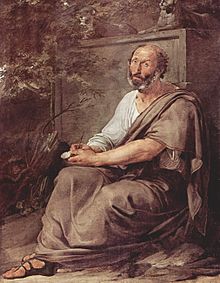
Aristotle is often said to be the father of natural law.[xi] Like his philosophical forefathers Socrates and Plato, Aristotle posited the existence of natural justice or natural right (dikaion physikon, δικαίον φυσικόν, Latin ius naturale). His clan with natural law is largely due to how he was interpreted by Thomas Aquinas.[12] This was based on Aquinas' conflation of natural law and natural correct, the latter of which Aristotle posits in Book V of the Nicomachean Ethics (Volume IV of the Eudemian Ethics). Aquinas's influence was such equally to affect a number of early translations of these passages,[13] though more recent translations return them more than literally.[14]
Aristotle'due south theory of justice is bound up in his thought of the golden mean. Indeed, his treatment of what he calls "political justice" derives from his discussion of "the just" as a moral virtue derived as the mean between opposing vices, just like every other virtue he describes.[15] His longest discussion of his theory of justice occurs in Nicomachean Ethics and begins by asking what sort of hateful a just act is. He argues that the term "justice" actually refers to two unlike but related ideas: general justice and detail justice.[xvi] [17] When a person's deportment toward others are completely virtuous in all matters, Aristotle calls them "just" in the sense of "general justice"; equally such, this thought of justice is more or less coextensive with virtue.[18] "Item" or "partial justice", by contrast, is the part of "general justice" or the private virtue that is concerned with treating others equitably.[17]
Aristotle moves from this unqualified discussion of justice to a qualified view of political justice, by which he means something close to the subject of modern jurisprudence. Of political justice, Aristotle argues that it is partly derived from nature and partly a matter of convention.[nineteen] This tin can be taken equally a statement that is similar to the views of modern natural law theorists. But it must also exist remembered that Aristotle is describing a view of morality, not a system of law, and therefore his remarks as to nature are nigh the grounding of the morality enacted as police force, not the laws themselves.
The best evidence of Aristotle's having idea there was a natural law comes from the Rhetoric, where Aristotle notes that, aside from the "particular" laws that each people has prepare upwardly for itself, there is a "common" law that is according to nature.[20] The context of this remark, all the same, suggests only that Aristotle thought that information technology could exist rhetorically advantageous to appeal to such a law, peculiarly when the "item" constabulary of one'southward own metropolis was adverse to the example beingness made, not that there actually was such a law.[21] Aristotle, moreover, considered sure candidates for a universally valid, natural law to be wrong.[22] Aristotle's theoretical paternity of the natural law tradition is consequently disputed.[23]
Thomas Aquinas [edit]

Thomas Aquinas was the nearly influential Western medieval legal scholar.
Thomas Aquinas is the foremost classical proponent of natural theology, and the father of the Thomistic schoolhouse of philosophy, for a long time the primary philosophical arroyo of the Roman Cosmic Church building. The work for which he is all-time known is the Summa Theologiae. 1 of the 30-five Doctors of the Church, he is considered by many Catholics to be the Church'due south greatest theologian. Consequently, many institutions of learning take been named after him.
Aquinas distinguished four kinds of police force: eternal, natural, divine, and homo:
- Eternal law refers to divine reason, known just to God. It is God's programme for the universe. Man needs this plan, for without it he would totally lack management.
- Natural constabulary is the "participation" in the eternal law by rational homo creatures, and is discovered by reason
- Divine law is revealed in the scriptures and is God'south positive constabulary for mankind
- Human being police is supported by reason and enacted for the mutual good.[24]
Natural police is based on "first principles":[25]
... this is the offset precept of the law, that expert is to be washed and promoted, and evil is to be avoided. All other precepts of the natural constabulary are based on this ...
The desires to live and to procreate are counted past Aquinas among those basic (natural) human values on which all other homo values are based.
School of Salamanca [edit]
Francisco de Vitoria was perhaps the outset to develop a theory of ius gentium (the rights of peoples), and thus is an important effigy in the transition to modernity. He extrapolated his ideas of legitimate sovereign power to international diplomacy, concluding that such affairs ought to be adamant by forms respecting of the rights of all and that the common good of the world should take precedence before the good of any single state. This meant that relations between states ought to pass from beingness justified by strength to existence justified past police force and justice. Some scholars have upset the standard account of the origins of International police, which emphasises the seminal text De iure belli air-conditioning pacis by Hugo Grotius, and argued for Vitoria and, afterwards, Suárez'south importance as forerunners and, potentially, founders of the field.[26] Others, such as Koskenniemi, have argued that none of these humanist and scholastic thinkers can be understood to have founded international constabulary in the modern sense, instead placing its origins in the post-1870 period.[27]
Francisco Suárez, regarded as amidst the greatest scholastics after Aquinas, subdivided the concept of ius gentium. Working with already well-formed categories, he carefully distinguished ius inter gentes from ius intra gentes. Ius inter gentes (which corresponds to modern international law) was something mutual to the majority of countries, although, being positive police force, not natural law, it was not necessarily universal. On the other paw, ius intra gentes, or civil law, is specific to each nation.
Lon Fuller [edit]
Writing later on World War II, Lon 50. Fuller dedicated a secular and procedural form of natural law. He emphasised that the (natural) law must see certain formal requirements (such as existence impartial and publicly knowable). To the extent that an institutional system of social command falls short of these requirements, Fuller argued, nosotros are less inclined to recognise it as a system of law, or to give it our respect. Thus, the law must have a morality that goes across the societal rules under which laws are made.
John Finnis [edit]
Sophisticated positivist and natural law theories sometimes resemble each other and may accept certain points in mutual. Identifying a particular theorist equally a positivist or a natural police theorist sometimes involves matters of emphasis and degree, and the particular influences on the theorist'south piece of work. The natural police force theorists of the distant by, such equally Aquinas and John Locke made no distinction between analytic and normative jurisprudence, while modern natural law theorists, such as John Finnis, who claim to exist positivists, still debate that law is moral by nature. In his volume Natural Law and Natural Rights (1980, 2011), John Finnis provides a restatement of natural law doctrine.[28]
Analytic jurisprudence [edit]
Analytic, or "clarificatory", jurisprudence means taking a neutral betoken of view and using descriptive language when referring to various aspects of legal systems. This was a philosophical development that rejected natural law'due south fusing of what law is and what it ought to exist.[4] David Hume argued, in A Treatise of Human Nature,[29] that people invariably slip from describing what the world is to asserting that we therefore ought to follow a detail course of action. Simply every bit a matter of pure logic, one cannot conclude that we ought to do something merely because something is the instance. So analysing and clarifying the way the world is must be treated every bit a strictly separate question from normative and evaluative questions of what ought to be done.
The most important questions of analytic jurisprudence are: "What are laws?"; "What is the police force?"; "What is the relationship betwixt law and power/sociology?"; and "What is the relationship between law and morality?" Legal positivism is the ascendant theory, although there is a growing number of critics who offering their own interpretations.
Historical school [edit]
Historical jurisprudence came to prominence during the contend on the proposed codification of German police force. In his volume On the Vocation of Our Age for Legislation and Jurisprudence,[30] Friedrich Carl von Savigny argued that Frg did not have a legal language that would back up codification because the traditions, customs, and beliefs of the High german people did non include a belief in a code. Historicists believe that police force originates with lodge.
Sociological jurisprudence [edit]
An effort to systematically inform jurisprudence from sociological insights developed from the beginning of the twentieth century, as sociology began to institute itself as a distinct social science, especially in the United States and in continental Europe. In Germany, Republic of austria and France, the work of the "free law" theorists (east.g. Ernst Fuchs, Hermann Kantorowicz, Eugen Ehrlich and Francois Geny) encouraged the utilize of sociological insights in the development of legal and juristic theory. The almost internationally influential advancement for a "sociological jurisprudence" occurred in the United States, where, throughout the outset one-half of the twentieth century, Roscoe Pound, for many years the Dean of Harvard Law School, used this term to characterise his legal philosophy. In the United States, many later writers followed Pound'south lead or developed distinctive approaches to sociological jurisprudence. In Australia, Julius Stone strongly dedicated and developed Pound'south ideas. In the 1930s, a pregnant divide betwixt the sociological jurists and the American legal realists emerged. In the second half of the twentieth century, sociological jurisprudence as a distinct movement declined as jurisprudence came more strongly under the influence of belittling legal philosophy; simply with increasing criticism of dominant orientations of legal philosophy in English language-speaking countries in the nowadays century, it has attracted renewed involvement. Increasingly, its contemporary focus is on providing theoretical resource for jurists to assist their agreement of new types of regulation (for example, the diverse kinds of developing transnational law) and the increasingly important interrelations of police and culture, especially in multicultural Western societies.[31]
Legal positivism [edit]
Legal positivism is the view that the content of police force is dependent on social facts and that a legal organisation's existence is not constrained by morality.[32] Within legal positivism, theorists concur that law'south content is a product of social facts, but theorists disagree whether law'south validity tin be explained by incorporating moral values.[33] Legal positivists who debate against the incorporation of moral values to explain police'southward validity are labeled exclusive (or difficult) legal positivists. Joseph Raz's legal positivism is an example of exclusive legal positivism. Legal positivists who argue that law'southward validity tin can be explained by incorporating moral values are labeled inclusive (or soft) legal positivists. The legal positivist theories of H. 50. A. Hart and Jules Coleman are examples of inclusive legal positivism.[34]
Thomas Hobbes [edit]
Hobbes was a social contractarian[35] and believed that the law had peoples' tacit consent. He believed that society was formed from a state of nature to protect people from the state of war that would exist otherwise. In Leviathan, Hobbes argues that without an ordered society life would exist "alone, poor, nasty, brutish and short."[36] It is unremarkably said that Hobbes's views on homo nature were influenced by his times. The English Civil War and the Cromwellian dictatorship had taken place; and, in reacting to that, Hobbes felt that absolute dominance vested in a monarch, whose subjects obeyed the law, was the basis of a civilized society.
Bentham and Austin [edit]
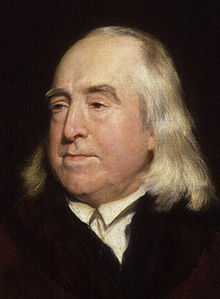
Bentham'due south utilitarian theories remained dominant in law until the twentieth century.
John Austin and Jeremy Bentham were early legal positivists who sought to provide a descriptive business relationship of law that describes the law every bit it is. Austin explained the descriptive focus for legal positivism by saying, "The existence of law is one matter; its merit and demerit some other. Whether it be or exist non is one research; whether it be or exist not conformable to an assumed standard, is a dissimilar enquiry."[37] For Austin and Bentham, a society is governed by a sovereign who has de facto say-so. Through the sovereign's potency come laws, which for Austin and Bentham are commands backed by sanctions for non-compliance. Along with Hume, Bentham was an early and staunch supporter of the utilitarian concept, and was an avid prison reformer, advocate for democracy, and house atheist. Bentham's views well-nigh law and jurisprudence were popularized by his student John Austin. Austin was the kickoff chair of law at the new University of London, from 1829. Austin'southward utilitarian reply to "what is law?" was that constabulary is "commands, backed by threat of sanctions, from a sovereign, to whom people have a habit of obedience".[38] H. L. A. Hart criticized Austin and Bentham'southward early legal positivism because the command theory failed to account for individual'southward compliance with the law.
Hans Kelsen [edit]
Hans Kelsen is considered one of the prominent jurists of the 20th century and has been highly influential in Europe and Latin America, although less and then in common-law countries. His Pure Theory of Police describes law as "bounden norms", while at the same time refusing to evaluate those norms. That is, "legal science" is to be separated from "legal politics". Fundamental to the Pure Theory of Law is the notion of a "bones norm" (Grundnorm)'—a hypothetical norm, presupposed past the jurist, from which all "lower" norms in the hierarchy of a legal system, beginning with constitutional law, are understood to derive their authority or the extent to which they are binding. Kelsen contends that the extent to which legal norms are bounden, their specifically "legal" character, can be understood without tracing it ultimately to some suprahuman source such as God, personified Nature or—of great importance in his fourth dimension—a personified State or Nation.
H. L. A. Hart [edit]
In the English-speaking globe, the almost influential legal positivist of the twentieth century was H. L. A. Hart, professor of jurisprudence at Oxford University. Hart argued that the constabulary should be understood as a organisation of social rules. In The Concept of Law, Hart rejected Kelsen's views that sanctions were essential to law and that a normative social miracle, like constabulary, cannot be grounded in non-normative social facts.
Hart claimed that constabulary is the union primary rules and secondary rules.[39] Chief rules require individuals to deed or not human action in certain ways and create duties for the governed to obey.[40] Secondary rules are rules that confer authority to create new main rules or alter existing ones.[twoscore] Secondary rules are divided into rules of arbitrament (how to resolve legal disputes), rules of change (how laws are amended), and the dominion of recognition (how laws are identified as valid). The validity of a legal system comes from the "dominion of recognition", which is a customary exercise of officials (especially barristers and judges) who place sure acts and decisions as sources of law. In 1981, Neil MacCormick[41] wrote a pivotal book on Hart (2nd edition published in 2008), which further refined and offered some important criticisms that led MacCormick to develop his own theory (the best example of which is his Institutions of Constabulary, 2007). Other important critiques include those of Ronald Dworkin, John Finnis, and Joseph Raz.
In recent years, debates on the nature of police accept become increasingly fine-grained. One important debate is inside legal positivism. One schoolhouse is sometimes chosen "exclusive legal positivism" and is associated with the view that the legal validity of a norm can never depend on its moral correctness. A 2d schoolhouse is labeled "inclusive legal positivism", a major proponent of which is Wil Waluchow, and is associated with the view that moral considerations may, but practise non necessarily, determine the legal validity of a norm.
Joseph Raz [edit]
Joseph Raz'southward theory of legal positivism argues against the incorporation of moral values to explain police force's validity. In Raz's 1979 volume The Authority of Law, he criticised what he called the "weak social thesis" to explain law.[42] He formulates the weak social thesis as "(a) Sometimes the identification of some laws turn on moral arguments, but also with, (b) In all legal systems the identification of some law turns on moral argument."[43] Raz argues that law's authority is identifiable purely through social sources, without reference to moral reasoning.[43] This view he calls "the sources thesis".[44] Raz suggests that whatever categorisation of rules beyond their office every bit authority is better left to folklore than to jurisprudence.[45] Some philosophers used to contend that positivism was the theory that held that there was "no necessary connection" between law and morality; only influential contemporary positivists—including Joseph Raz, John Gardner, and Leslie Green—reject that view. As Raz points out, it is a necessary truth that there are vices that a legal system cannot maybe have (for example, it cannot commit rape or murder).
Legal realism [edit]
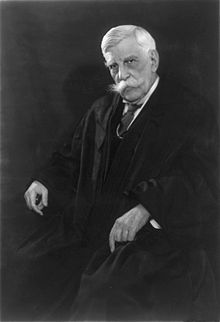
Legal realism is the view that a theory of constabulary should be descriptive and business relationship for the reasons why judges decide cases every bit they practise.[46] Legal realism had some affinities with the sociology of law and sociological jurisprudence. The essential tenet of legal realism is that all law is made by humans and thus should account for reasons too legal rules that led to a legal decision.
There are two carve up schools of legal realism: American legal realism and Scandinavian legal realism. American legal realism grew out of the writings of Oliver Wendell Holmes. At the start of Holmes's The Common Police, he claims that "[t]he life of the law has non been logic: it has been feel".[47] This view was a reaction to legal formalism that was pop the fourth dimension due to the Christopher Columbus Langdell.[48] Holmes'due south writings on jurisprudence too laid the foundations for the predictive theory of law. In his article "The Path of the Law", Holmes argues that "the object of [legal] report...is prediction, the prediction of the incidence of the public strength through the instrumentality of the courts."[49]
For the American legal realists of the early on twentieth century, legal realism sought to describe the mode judges determine cases. For legal realists such every bit Jerome Frank, judges start with the facts earlier them and so motility to legal principles. Before legal realism, theories of jurisprudence turned this method around where judges were thought to begin with legal principles and so look to facts.
It has go common today to identify Justice Oliver Wendell Holmes Jr., every bit the main precursor of American Legal Realism (other influences include Roscoe Pound, Karl Llewellyn, and Justice Benjamin Cardozo). Karl Llewellyn, another founder of the U.South. legal realism motility, similarly believed that the law is fiddling more than than putty in the hands of judges who are able to shape the consequence of cases based on their personal values or policy choices.[50]
The Scandinavian schoolhouse of legal realism argued that police can be explained through the empirical methods used by social scientists.[51] Prominent Scandinavian legal realists are Alf Ross, Axel Hägerström, and Karl Olivecrona. Scandinavian legal realists also took a naturalist arroyo to law.[52]
Despite its decline in popularity, legal realism continues to influence a broad spectrum of jurisprudential schools today, including critical legal studies, feminist legal theory, critical race theory, folklore of law, and constabulary and economics.[53]
Critical legal studies [edit]
Critical legal studies are a new theory of jurisprudence that has developed since the 1970s. The theory can more often than not be traced to American legal realism and is considered "the get-go movement in legal theory and legal scholarship in the United States to take espoused a committed Left political stance and perspective".[54] It holds that the law is largely contradictory, and can be best analyzed as an expression of the policy goals of a ascendant social group.[55]
Critical rationalism [edit]
Karl Popper originated the theory of critical rationalism. According to Reinhold Zippelius many advances in law and jurisprudence take place by operations of critical rationalism. He writes, "daß die Suche nach dem Begriff des Rechts, nach seinen Bezügen zur Wirklichkeit und nach der Gerechtigkeit experimentierend voranschreitet, indem wir Problemlösungen versuchsweise entwerfen, überprüfen und verbessern" (that nosotros empirically search for solutions to problems, which harmonise fairly with reality, by projecting, testing and improving the solutions).[56]
Legal interpretivism [edit]
American legal philosopher Ronald Dworkin's legal theory attacks legal positivists that split law's content from morality.[57] In his volume Police'southward Empire,[58] Dworkin argued that law is an "interpretive" concept that requires barristers to find the best-plumbing fixtures and most only solution to a legal dispute, given their constitutional traditions. According to him, police force is not entirely based on social facts, but includes the all-time moral justification for the institutional facts and practices that form a society'due south legal tradition. It follows from Dworkin's view that one cannot know whether a society has a legal system in forcefulness, or what any of its laws are, until one knows some truths about the moral justifications of the social and political practices of that society. It is consistent with Dworkin's view—in contrast with the views of legal positivists or legal realists—that no-one in a society may know what its laws are, because no-one may know the all-time moral justification for its practices.
Estimation, according to Dworkin'south "integrity theory of constabulary", has two dimensions. To count as an interpretation, the reading of a text must meet the criterion of "fit". Of those interpretations that fit, however, Dworkin maintains that the right interpretation is the 1 that portrays the practices of the customs in their all-time light, or makes them "the all-time that they tin can be". Merely many writers have doubted whether there is a unmarried best moral justification for the circuitous practices of any given community, and others have doubted whether, even if there is, it should be counted equally part of the law of that customs.
Therapeutic jurisprudence [edit]
Consequences of the operation of legal rules or legal procedures—or of the beliefs of legal actors (such every bit lawyers and judges)—may be either beneficial (therapeutic) or harmful (anti-therapeutic) to people. Therapeutic jurisprudence ("TJ") studies law as a social force (or amanuensis) and uses social science methods and data to written report the extent to which a legal rule or practice affects the psychological well-being of the people information technology impacts.[59]
Normative jurisprudence [edit]
In addition to the question, "What is constabulary?", legal philosophy is also concerned with normative, or "evaluative" theories of law. What is the goal or purpose of police? What moral or political theories provide a foundation for the law? What is the proper function of police force? What sorts of acts should be bailiwick to punishment, and what sorts of punishment should be permitted? What is justice? What rights do we have? Is at that place a duty to obey the law? What value has the dominion of police force? Some of the different schools and leading thinkers are discussed below.
Virtue jurisprudence [edit]
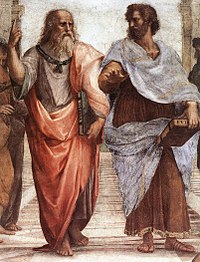
Aretaic moral theories, such equally contemporary virtue ethics, emphasize the function of character in morality. Virtue jurisprudence is the view that the laws should promote the evolution of virtuous character in citizens. Historically, this approach has been mainly associated with Aristotle or Thomas Aquinas. Contemporary virtue jurisprudence is inspired past philosophical work on virtue ethics.
Deontology [edit]
Deontology is the "theory of duty or moral obligation".[60] The philosopher Immanuel Kant formulated 1 influential deontological theory of law. He argued that whatever rule we follow must exist able to be universally practical, i.e. nosotros must be willing for everyone to follow that rule. A contemporary deontological approach can exist found in the piece of work of the legal philosopher Ronald Dworkin.
Utilitarianism [edit]

Mill believed constabulary should create happiness.
Utilitarianism is the view that the laws should be crafted and so every bit to produce the best consequences for the greatest number of people. Historically, commonsensical thinking about law has been associated with the philosopher Jeremy Bentham. John Stuart Factory was a pupil of Bentham's and was the torch bearer for utilitarian philosophy throughout the late nineteenth century.[61] In contemporary legal theory, the utilitarian approach is often championed by scholars who work in the police force and economics tradition.[53]
John Rawls [edit]
John Rawls was an American philosopher; a professor of political philosophy at Harvard University; and writer of A Theory of Justice (1971), Political Liberalism, Justice as Fairness: A Restatement, and The Law of Peoples. He is widely considered one of the most important English language-language political philosophers of the 20th century.[62] [63] [64] His theory of justice uses a method called "original position" to ask us which principles of justice nosotros would choose to regulate the basic institutions of our gild if we were behind a "veil of ignorance". Imagine we exercise not know who we are—our race, sex, wealth, status, grade, or whatever distinguishing feature—so that we would not be biased in our own favour. Rawls argued from this "original position" that we would choose exactly the aforementioned political liberties for everyone, similar liberty of spoken communication, the right to vote, and so on. Also, we would choose a organisation where in that location is just inequality because that produces incentives plenty for the economical well-being of all society, especially the poorest. This is Rawls'due south famous "difference principle". Justice is fairness, in the sense that the fairness of the original position of selection guarantees the fairness of the principles chosen in that position.
There are many other normative approaches to the philosophy of law, including critical legal studies and libertarian theories of law.
Encounter also [edit]
- Analytical jurisprudence
- Artificial intelligence and police
- Brocard (law)
- Cautelary jurisprudence
- Comparative law
- Constitution
- Constitutional law
- Constitutionalism
- Constitutional economics
- Critical legal studies
- Critical race theory
- Critical rationalism
- Defeasible reasoning
- Divine law
- Feminist jurisprudence
- Feminist legal theory
- Fiqh
- International legal theory
- Judicial activism
- Justice
- Law and economics
- Law and literature
- Legal formalism
- Legal history
- Legalism
- Legal pluralism
- Legal positivism
- Legal realism
- Legal science
- Libertarian theories of constabulary
- Living Constitution
- Originalism
- Natural police
- New legal realism
- Political jurisprudence
- Postmodernist jurisprudence
- Publius Juventius Celsus
- Philosophy of law
- Rule of law
- Rule according to college police force
- Sociological jurisprudence
- Folklore of law
- Strict interpretation
- Virtue jurisprudence
Notes [edit]
- ^ LII Staff (6 Baronial 2007). "Jurisprudence". LII / Legal Information Institute . Retrieved 22 September 2018.
- ^ Garner, Bryan A. (2009). Blackness's law lexicon (9th ed.). Saint Paul, Minnesota, USA: West. pp. Jurisprudence entry. ISBN978-0-314-19949-2.
- ^ a b Shiner, "Philosophy of Police", Cambridge Dictionary of Philosophy
- ^ a b Run into H L A Hart, 'Positivism and the Separation of Police and Morals' (1958) 71 Harv. 50. Rev. 593
- ^ Soper, "Legal Positivism", Cambridge Lexicon of Philosophy
- ^ "jurisprudence - Wiktionary". en.wiktionary.org . Retrieved 24 May 2019.
- ^ Oxford English language Lexicon, second edition 1989
- ^ Katju, Markandey (27 Nov 2010). "Ancient Indian Jurisprudence" (PDF). Banaras Hindu University . Retrieved 11 Apr 2019.
- ^ Chang, Wejen (Spring 2010). "Classical Chinese Jurisprudence and the Development of the Chinese Legal System". Tsinghua China Police Review. 2 (ii). Retrieved 27 June 2019.
- ^ The Blackwell Guide to the Philosophy of Constabulary and Legal Theory. Golding, Martin P. (Martin Philip), 1930-, Edmundson, William A. (William Atkins), 1948-, Ideology Reference. Malden, Mass.: Blackwell Pub. 2013. ISBN9781782683131. OCLC 841495455.
{{cite volume}}: CS1 maint: others (link) - ^ Shellens, "Aristotle on Natural Police."
- ^ Jaffa, Thomism and Aristotelianism.
- ^ H. Rackham, trans., Nicomachean Ethics, Loeb Classical Library; J. A. M. Thomson, trans. (revised by Hugh Tedennick), Nicomachean Ethics, Penguin Classics.
- ^ Joe Sachs, trans., Nicomachean Ethics, Focus Publishing
- ^ "Nicomachean Ethics" Bk. Ii ch. 6
- ^ Terrence Irwin, trans. Nicomachean Ideals, second Ed., Hackett Publishing
- ^ a b Nicomachean Ideals, Bk. V, ch. iii
- ^ "Nicomachean Ethics", Bk. V, ch. 1
- ^ Nicomachean Ethics, Bk. V, ch. 7.
- ^ Rhetoric 1373b2–8.
- ^ Shellens, "Aristotle on Natural Law," 75–81
- ^ "Natural Law," International Encyclopedia of the Social Sciences.
- ^ "Greek Theory of Natural Law".
- ^ Louis Pojman, Ethics (Belmont, CA: Wadsworth Publishing Visitor, 1995)
- ^ "Summa Theologica".
- ^ e.g. James Dark-brown Scott, cited in Cavallar, The Rights of Strangers: theories of international hospitality, the global community, and political justice since Vitoria, p.164
- ^ Koskenniemi: "International Law and raison d'état: Rethinking the Prehistory of International Law", in Kingsbury & Strausmann, The Roman Foundations of the Law of Nations, pp. 297–339
- ^ Finnis, John (1980). Natural Law and Natural Rights. Oxford: Clarendon Press. pp. 18–19.
- ^ David Hume, A Treatise of Human Nature (1739) Etext Archived 20 Baronial 2006 at the Wayback Automobile
- ^ Friedrich Carl von Savigny, On the Vocation of Our Age for Legislation and Jurisprudence (Abraham A. Hayward trans., 1831)
- ^ For full discussion see Cotterrell 2018
- ^ Green, Leslie (Leap 2018). "Legal Positivism". The Stanford Encyclopedia of Philosophy.
- ^ Tater, Mark C. (2006). Philosophy of law: the fundamentals. Malden, MA: Blackwell. pp. 132–135. ISBN9781405129466. OCLC 62281976.
- ^ Himma, Kenneth Einar. "Legal Positivism". The Internet Encyclopedia of Philosophy . Retrieved 31 May 2019.
- ^ Martinich, A.P. (2013). Hobbes. New York: Routledge. p. 54. ISBN9781135180799.
- ^ Hobbes, Thomas (1668). "Of the Natural Condition of Mankind". In Curley, Edwin (ed.). Leviathan: With selected variants from the Latin edition of 1668. Hackett Publishing. p. 76. ISBN9781603844857.
- ^ Austin, John (1832). The province of jurisprudence determined ; and, the uses of the study of jurisprudence. Indianapolis, IN: Hackett Pub. p. 184. ISBN0872204332. OCLC 39539515.
- ^ John Austin, The Providence of Jurisprudence Determined (1831)
- ^ Hart, H. 50. A. (2012). The Concept of Law (tertiary ed.). Oxford: Oxford Academy Printing. pp. 79–99.
- ^ a b Hart, H. Fifty. A. (2012). The Concept of Constabulary (3rd ed.). Oxford: Oxford University Press. p. 81.
- ^ "The University of Edinburgh". Archived from the original on one June 2006. Retrieved 24 May 2006.
- ^ Raz, Joseph (1979). The Authority of Law: Essays on Law and Morality. Oxford: Oxford University Press. p. 45. ISBN9780199573561.
- ^ a b Raz, Joseph (1979). The Authority of Law: Essays on Law and Morality. Oxford: Oxford University Press. p. 47. ISBN9780199573561.
- ^ Raz, Joseph (1979). The Dominance of Police force: Essays on Law and Morality. Oxford: Oxford Academy Press. pp. 47–48. ISBN9780199573561.
- ^ ch. ii, Joseph Raz, The Authority of Police force (1979)
- ^ Leiter, Brian (December 1997). "Rethinking Legal Realism: Toward a Naturalized Jurisprudence". Texas Police Review. 76: 268.
- ^ Holmes Jr., O.W. (1881). The Common Law. Boston: Little, Brown, and Co. p. ane.
- ^ Langdell, C.C. (1871). A Selection of Cases on the Constabulary of Contracts. Boston: Niggling, Dark-brown, and Co. pp. vi.
- ^ Holmes, O.West. (1897). "The Path of the Police force". Harvard Law Review. 10 (eight): 457–478. doi:10.2307/1322028. JSTOR 1322028.
- ^ "Jurisprudence". W's Encyclopedia of American Police force. Ed. Jeffrey Lehman, Shirelle Phelps. Detroit: Thomson/Gale, 2005.
- ^ Schauer, Frederick (2009). Thinking Similar a Lawyer. Cambridge: Harvard University Press. pp. 124 n.1. ISBN9780674032705.
- ^ Olivecrona, Karl (1971). Law as Fact. London: Stevens & Sons. pp. 7. ISBN978-0420432506.
- ^ a b Kristoffel Grechenig & Martin Gelter, The Transatlantic Divergence in Legal Thought: American Law and Economics vs. German language Doctrinalism, Hastings International and Comparative Police Review 2008, vol. 31, pp. 295–360.
- ^ Alan Chase, "The Theory of Critical Legal Studies," Oxford Periodical of Legal Studies, Vol. 6, No. i (1986): 1-45, esp. 1, 5. See [1]. DOI, 10.1093/ojls/6.i.i.
- ^ Moore, "Critical Legal Studies", Cambridge Dictionary of Philosophy
- ^ Reinhold Zippelius, Rechtsphilosophie, six. Aufl. 2011 Vorwort.
- ^ Brooks, "Review of Dworkin and His Critics with Replies by Dworkin", Modernistic Constabulary Review, vol. 69 no. half dozen
- ^ Ronald Dworkin, Law'due south Empire (1986) Harvard University Press
- ^ Wexler, David B; Perlin, Michael Fifty; Vols, Michel; et al. (December 2016). "Editorial: Current Issues in Therapeutic Jurisprudence". QUT Law Review. 16 (iii): 1–3. doi:ten.5204/qutlr.v16i3.692. ISSN 2201-7275.
- ^ Webster's New World Dictionary of the American Language, p. 378 (2d Coll. Ed. 1978).
- ^ see, Utilitarianism Archived five May 2007 at the Wayback Machine at Metalibri Digital Library
- ^ Nussbaum, Martha (twenty July 2001). "The Enduring Significance of John Rawls" (PDF). The Chronicle of Higher Education.
John Rawls, who turned 80 this year, is the most distinguished moral and political philosopher of our historic period.
- ^ Dorf, Michael C. (xi December 2002). "In Praise of John Rawls, The Man Who Made Moral Philosophy Respectable Again – And Whose Views Too Profoundly Informed American Legal Thought". FindLaw.
Rawls remained the most of import American philosopher since John Dewey.
- ^ Jedediah, Purdy (29 Oct 2019). "What John Rawls Missed". The New Republic.
John Rawls, who died in 2002, was the most influential American philosopher of the twentieth century.
References [edit]
- Hastings International and Comparative Constabulary Review 2008, vol. 31, pp. 295–36.
Further reading [edit]
- Austin, John (1831). The Province of Jurisprudence Determined.
- Cotterrell, R. (1995). Law's Community: Legal Theory in Sociological Perspective. Oxford: Oxford University Press.
- Cotterrell, R. (2003). The Politics of Jurisprudence: A Critical Introduction to Legal Philosophy, 2d ed. Oxford: Oxford University Press.
- Cotterrell, R. (2018). Sociological Jurisprudence: Juristic Thought and Social Inquiry. New York/London: Routledge.
- Freeman, K. D. A. (2014). Lloyd's Introduction to Jurisprudence. 9th ed. London: Sweet and Maxwell.
- Hart, H. L. A. (1994) [1961]. The Concept of Law (2nd (with postscript) ed.). Oxford: Clarendon Press. ISBN978-0-19-876122-8.
- Hartzler, H. Richard (1976). Justice, Legal Systems, and Social Structure. Port Washington, NY: Kennikat Printing.
- Engle, Eric (July 2010). Lex Naturalis, Ius Naturalis: Law as Positive Reasoning & Natural Rationality. Eric Engle. ISBN978-0-9807318-4-2.
- Hutchinson, Allan C., ed. (1989). Disquisitional Legal Studies. Totowa, NJ: Rowman & Littlefield.
- Kempin Jr., Frederick G. (1963). Legal History: Constabulary and Social Alter. Englewood Cliffs, NJ: Prentice-Hall.
- Llewellyn, Karl Due north. (1986). Karl N. Llewellyn on Legal Realism. Birmingham, AL: Legal Classics Library. (Contains penetrating archetype "The Bramble Bush" on nature of law).
- Murphy, Cornelius F. (1977). Introduction to Police force, Legal Process, and Procedure. St. Paul, MN: Due west Publishing.
- Rawls, John (1999). A Theory of Justice, revised ed. Cambridge: Harvard University Press. (Philosophical treatment of justice).
- Wacks, Raymond (2009). Understanding Jurisprudence: An Introduction to Legal Theory Oxford Academy Press.
- Washington, Ellis (2002). The Inseparability of Law and Morality: Essays on Law, Race, Politics and Organized religion University Press of America.
- Washington, Ellis (2013). The Progressive Revolution, 2007–08 Writings-Vol. 1; 2009 Writings-Vol. two, Liberal Fascism through the Ages University Press of America.
- Zinn, Howard (1990). Declarations of Independence: Cross-Examining American Ideology. New York: Harper Collins Publishers.
- Zippelius, Reinhold (2011). Rechtsphilosophie, 6th ed. Munich: C.H. Brook. ISBN 978-iii-406-61191-ix
- Zippelius, Reinhold (2012). Das Wesen des Rechts (The Concept of Police force), an introduction to Legal Theory, 6th ed., Stuttgart: Westward. Kohlhammer. ISBN 978-3-17-022355-4
- Zippelius, Reinhold (2008). Introduction to German language Legal Methods (Juristische Methodenlehre), translated from the 10th German Edition by Kirk Due west. Junker, P. Matthew Roy. Durham: Carolina Academic Press.
- Heinze, Eric, The Concept of Injustice (Routledge, 2013)
- Pillai, P. S. A. (2016). Jurisprudence and Legal Theory, tertiary Edition, Reprinted 2016: Eastern Book Company. ISBN 978-93-5145-326-0
External links [edit]
- John Witte Jr.: A Cursory Biography of Dooyeweerd, based on Hendrik van Eikema Hommes, Inleiding tot de Wijsbegeerte van Herman Dooyeweerd (The Hague, 1982; pp. 1–4, 132). Redeemer University College
- LII Law near ... Jurisprudence.
- [2]Lircocervo.it "Fifty'Ircocervo. Rivista elettronica italiana di metodologia giuridica, teoria generale del diritto east dottrina dello stato"
- The Case of the Speluncean Explorers: Ix New Opinions, by Peter Suber (Routledge, 1998.) Lon Fuller's classic of jurisprudence brought up to date 50 years later on.
- The Roman Law Library, incl. Responsa prudentium by Professor Yves Lassard and Alexandr Koptev.
- Evgeny Pashukanis - General Theory of Constabulary and Marxism.
- Internet Encyclopedia: Philosophy of Police.
- The Opticon: Online Repository of Materials covering Spectrum of U.S. Jurisprudence.
- Foundation for Constabulary, Justice and Society
- Bibliography on the Philosophy of Law. Peace Palace Library
- Norwegian Association for Legal Philosophy
Source: https://en.wikipedia.org/wiki/Jurisprudence
0 Response to "Business Ethics: Case Studies and Selected Readings, 9th Edition Pdf Download"
Post a Comment